
Nice in the Off Season: Flânerie, Art, Food & the Côte d’Azur

Updated: Sep 15
Why Visit Nice in the Off Season?
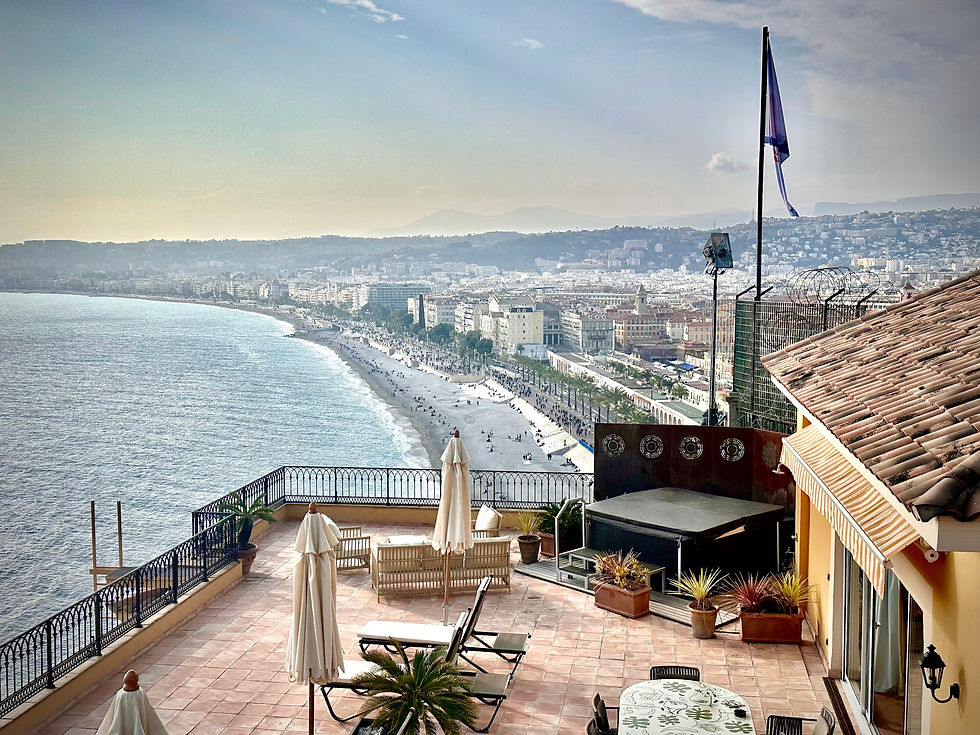
Nice became a fashionable escape in the 19th century when wealthy British and European visitors came for its mild winters, not its summers. The Promenade des Anglais is a reminder of those early British visitors, and more than a century later, winter is still a pretty good time to be here.
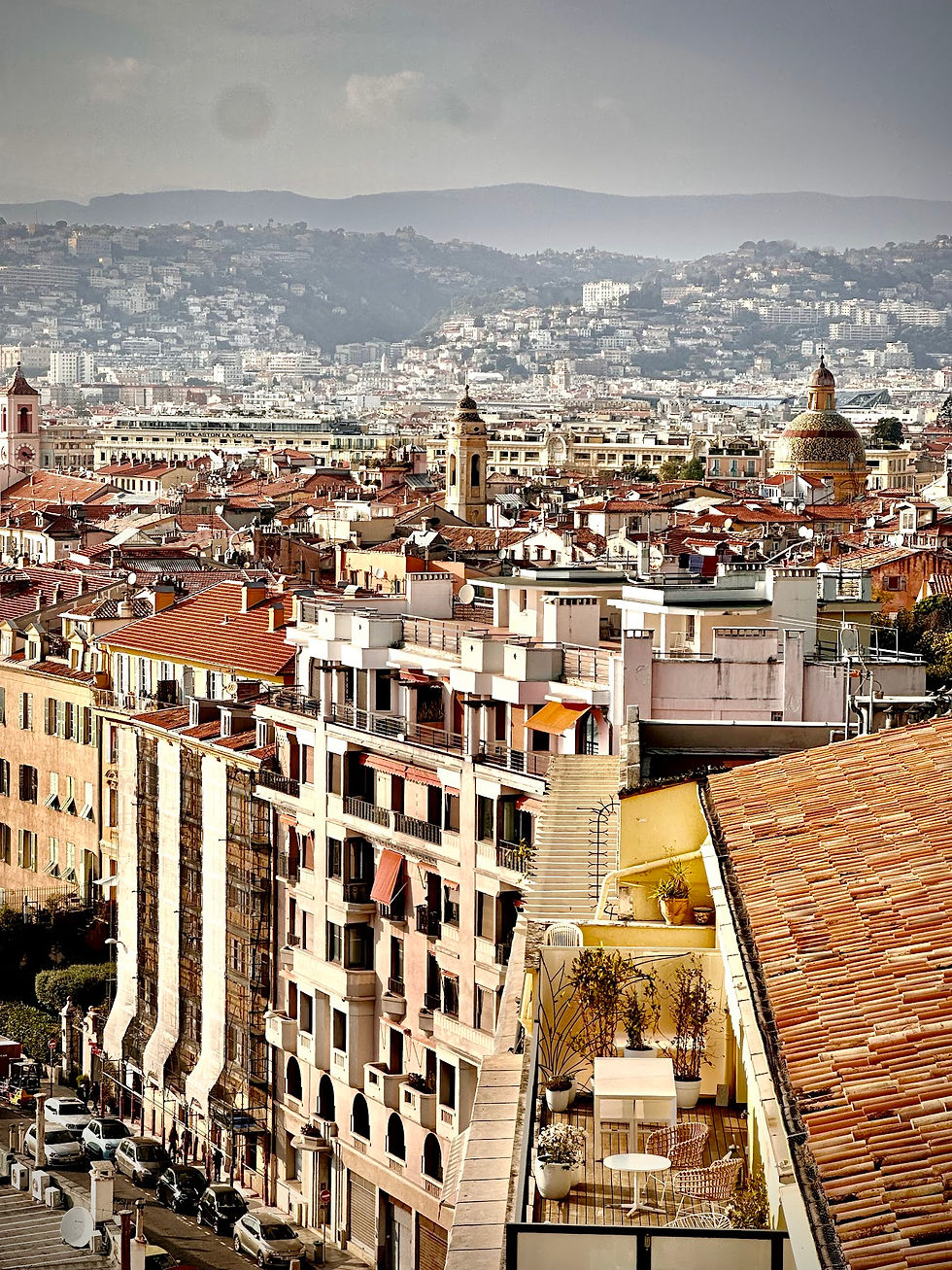
Summer has the beaches, warm Mediterranean water and long evenings, but it also has crowds. Off-season, Nice is cooler and easier to explore on foot, restaurants are easier to book, and you can actually see the art in the museums without quite so many heads in your way. In case of a rainy day (they do happen), bring a lightweight raincoat and shoes that will stay dry, and become a flâneur. If the indoors beckons, there are museums, wine bars, cafés, shops and plenty of places to settle in for a few hours.
Nice also makes a great base. Trains run along the coast to Antibes, Èze, Monaco and Menton, and the airport is close to the center. You can unpack once and decide each morning whether to explore the city or go somewhere else.
The Beach and Alps on the Same Day
While you are sitting along the Mediterranean, it is easy to forget that the Alps and ski areas are not far away. Auron and Isola 2000 are both within reach of Nice, and at the right time of year you really can ski and walk along the beach on the same day!
The mountains will get considerably more attention when the French Alps host the 2030 Olympic and Paralympic Winter Games, another good reason to remember that the Côte d'Azur is more than a summer destination.
Flânerie in Vieux Nice
Streets of Nice are beautiful even in the off-season Beautiful Pastels of Nice Don't Miss the Details of the Historic Old Town Stop for a Refresher as you wander Fountain statue in Old Town
The streets and walking areas of Old Town Nice - ©Holman Photography 2026
Vieux Nice is colorful, crowded, slightly chaotic and made for wandering. The ochre, apricot and yellow buildings feel more Italian than French, and there is a reason: Nice belonged to the House of Savoy and later the Kingdom of Sardinia before becoming part of France in 1860. The Italian influence remains in the architecture, language and food.
Start around Cours Saleya, but don't hurry through it. On most mornings it will delight you with flowers, produce, olives, spices and local specialties. On Monday the food stalls give way to a brocante, and tables fill with silver, paintings, china, old linens, jewelry and all sorts of French treasures. I happened to be there for the antiques and loved it. Plus, the people watching was nearly as good as the shopping.
The Brocante Market at Saleya Monk strolls the markets in Nice Saleya market offers a feast for the eyes Glasswares Saleya antique market Art is everywhere in Nice
Antiques Market in Old Town Nice
Nice has its own foods that are fun to try, including socca, pissaladière, petits farcis and pan bagnat. And leave room for the pâtisseries and confectionery shops(!). I found one filled with chocolates, candied citrus and jewel-like pâtes de fruits lined up behind the glass, beautiful even if you don't buy.
The candied fruits are as pretty as they are good Sweep shop is worth a stop Wine and pissaladiere
Sweets shop and Wine and Apps on Cours Saleya, Nice
Eating and Drinking in Nice
I would not turn Vieux Nice into a restaurant checklist, because part of its appeal is finding things as you go, but I would put a few places on the map.
Maison Péllégrino combines an épicerie fine, wine cellar and restaurant, with cheese, charcuterie, wine and plenty of things you may suddenly decide you simply must have. Lavomatique, on rue du Pont Vieux, is tiny and more contemporary, with an open kitchen, sharing plates and an interesting wine list. Les Vieux is a good place to stop for an apéro, cheese and charcuterie.
For a local menu (think pissaladière, petits farcis, daube with Niçois ravioli and local cheeses) seek out La Cave de la Tour. It is a family-run Niçois cave and restaurant that has been around since 1947. This is the kind of place worth a stop-in over whatever restaurant happens to be trending.

Le Plongeoir will give you a very different kind of setting as it sits dramatically on the rocks above the Mediterranean. The restaurant can be eached by a little footbridge, with tables seemingly suspended over the water. This is one I would book for the combination of food, setting and view.
High on my list for an evening is Le Bistrot des Serruriers, which sits away from the busiest part of Old Nice, just below Hôtel du Couvent. It is small, cozy, simply adorned and very French. I was one of four solo diners the evening I went and did not get even an inkling of disapproval as can often happen eating alone. The staff was attentive and worked as a team, so everything came in a timely manner, and their English was impeccable.
The food wowed me, and I am not easily wowed. I ordered the confit chicken thigh and started talking to myself after the first bite about how good it was. It came with a creamy pepper sauce that enhanced the potatoes to the extent that I could not stop eating them. Their wines lean toward natural wines, so ask for a taste before ordering if those are not usually your thing. The staff is very knowledgeable about the wine and happy to help.
Three Hotels to Consider in Nice
I stayed at Hôtel La Pérouse, tucked against Castle Hill at the end of the Promenade des Anglais, and would happily stay there again. My room looked across the terracotta rooftops toward the Baie des Anges and Mediterranean, and I could walk out the door into Old Nice or along the water. The hotel has a pool tucked into the rock and Le Patio, a lovely restaurant and terrace under lemon trees.
Castle hill and the promenade bedroom at Hotel La Pérouse Le Patio-- lovely breakfast spot bar of shells and tiles lends character at Le Patio
Quai des Etats-Unis, Hotel La Pérouse standard room and their Le Patio restaurant
Hôtel du Couvent is an entirely different experience. While I did not stay there, the Bistrot des Serruriers is part of the hotel and gave me an excuse to explore. The restored 17th-century convent sits above Old Nice behind walls and gardens, with four pools, Roman-inspired baths, a movement studio, herbalist and bakery. This is one of those hotels that exudes character, down to the color of white they chose for the walls. Some rooms are intentionally spare and TV-free, so this is worth choosing for the experience as much as the room.
For the grand luxury version of Nice, Le Negresco is impossible to miss on the Promenade des Anglais. The privately owned palace is almost a museum in its own right, filled with antiques and an extensive collection of French art ranging from historic pieces to contemporary works. Every room is different, and the bold interiors are part of the fun. Even if you don't stay, there is La Rotonde for breakfast or a more casual meal, the Michelin-starred Le Chantecler, and bars for a drink. This is Nice at its most theatrical.
Activities : Castle Hill, a Waterfall, Views and a Mercedes
Castle Hill view of Nice beach waterfall at the top of castle hill Stairs leading up Castle Hill
View from Castle Hill, the Waterfall up top and the staircase to climb
From Vieux Nice, get your steps in by climbing up Colline du Château for the waterfall, gardens and views over the Baie des Anges. There is no castle anymore, but the hill is one of the best places to get above the rooftops. If you are staying at La Pérouse and already waking up to that view, the panorama alone may not be enough reason to climb. I found the cemeteries more interesting.
The Cimetière du Château is filled with elaborate sculpture, mausoleums and monuments, and the historic Jewish cemetery sits next to it. Emil Jellinek is buried here whose daughter, Mercédès, gave her name to the Daimler cars he promoted, eventually giving us Mercedes-Benz. It is an unexpected little piece of history in an extraordinarily beautiful setting.
Cimitiere du Château is full of history Emil Jellinek- Mercedes headstone enscription
Cimitière du Château Emil Jellinek Mercedes
Nice Art (Get It?)
Nice has enough art to occupy several days, and the off-season makes museum-going considerably more pleasant. If the weather happens to be wet, all the better. It is best not to rely on the old assumption that museums in France close on Monday. Nice's museums have different closing days- several close Tuesdays- so check before heading out.
The Musée Matisse is up in Cimiez, where Matisse spent much of his later life. The nearby Musée National Marc Chagall houses the Biblical Message paintings around which the museum was created during Chagall's lifetime.
In Vieux Nice, the Musée de la Photographie Charles Nègre, near Cours Saleya, is quite worth a visit if you are a photo buff. Check the hours before you go.
Palais Lascaris, on rue Droite in Old Nice, gives you a completely different experience: a lavish 17th-century Baroque palace with a remarkable collection of historic musical instruments. Farther west along the Promenade, near the Negresco, Villa Masséna is the place to dig into the history of Nice and the Riviera.
Venture Beyond Old Nice
After exploring Vieux Nice, venture farther afield and discover a few neighborhoods where the city changes character.
Cimiez is an easy place to start, particularly because you may already be heading there for Matisse. Long before Nice became a fashionable resort, this was the Roman city of Cemenelum. The remains of Roman baths and an amphitheater sit near the museum, along with the olive-filled gardens of the Arènes de Cimiez and the Monastère de Cimiez. The neighborhood later became fashionable all over again during the Belle Époque, when wealthy Europeans came to Nice for the winter. Queen Victoria stayed here, and the enormous former Excelsior Régina Palace still overlooks the neighborhood.

For something livelier, head around Castle Hill toward Port Lympia. Colorful traditional boats share the harbor with considerably larger neighbors, and the streets between the port and Place Garibaldi, especially around rue Bonaparte, are good territory for cafés, wine bars and restaurants.
If you love markets, take the tram north one morning to Libération. The Marché de la Libération is less polished for visitors than Cours Saleya, with locals buying vegetables, fish, cheese and whatever they need for dinner.
Easy day trips from Nice
Nice's trains make it almost too easy to add another place to the day.
Saint-Jean-Cap-Ferrat is an easy escape from Nice, and one I would add especially if you like to walk. Villa Ephrussi de Rothschild is worth a visit for the house, art and extraordinary gardens, but don't stop there. Walk the coastal path which wraps around the peninsula between rocky coves, little beaches to see some spectacular stretches of Mediterranean. Wear close-toed shoes rather than flip-flops (nd check conditions before setting out as the path can close in rough weather). This adventure can be the sort of excursion that makes the Riviera so appealing outside the heat of summer.
Èze sits high above the Mediterranean, a medieval village of stone lanes and enormous views. It is popular and can get busy, but there is a reason everyone goes. One useful bit of advice: don't assume the train is the easiest way to get there. Èze-sur-Mer station is down at sea level; for the medieval village, take the bus from Nice, which delivers you considerably closer to where you actually want to be. Once there, wander uphill through the village and stop for a drink at Château de la Chèvre d'Or, perched on the cliff with one of those ridiculously gorgeous Riviera views that stretches in both directions along the coast.
Monaco is close enough to visit for a few hours. There are museums, gardens, the casino and an astonishing concentration of yachts, cars and wealth. The opulence is part of the spectacle, but so are the prices; if that isn't your thing, you don't need to devote an entire day to it.
Continue toward the Italian border for Menton, with pastel buildings, gardens and a stronger Italian influence. If you are traveling in February, its famous Fête du Citron runs February 13–28, 2027, with enormous sculptures made from citrus, parades and evening events. It is technically off-season, but definitely not uncrowded during the festival.
For another direction entirely, head inland to Saint-Paul-de-Vence, one of the Riviera's great art villages. Its history is entwined with the artists who came here in the 20th century, and La Colombe d'Or became part inn, part gathering place, part extraordinary private art collection. Matisse, Picasso, Braque, Léger, Calder and Chagall were among its regulars, and their work still hangs there. This is one place where lunch is as much about the beauty and history on the walls as what arrives on the plate.
And west of Nice, Biot is a good choice for art and craftsmanship, particularly its long tradition of glassmaking. Galleries and workshops are scattered through the old hill village, making it another good place to explore without much of a plan.
If you want something completely different, Cannes has an underwater museum just off Île Sainte-Marguerite. Six enormous faces by British artist Jason deCaires Taylor sit three to five meters below the surface and can be seen with a mask and snorkel. The sculptures were made from casts of local residents and designed to become part of the marine ecosystem over time. Access to the museum itself is free.
Antibes
I was lucky enough to have a dear friend with a place in Antibes show me around, so I saw more than I would have on a quick day trip. Even though it was chilly and flowers were not blooming, it was still crowded. I kept thinking, “If this is quiet season, I can only imagine those little streets in July and August”.
The Marché Provençal is lovely, filled with cheeses, nougat, produce and local foods. Fromagerie de l'Étable is worth finding for wine and cheese, and Bistro Jules and Don Juan were two little restaurants on opposite corners (same owner), decorated with traditional Niçois trinkets and art- very cute. There are ice cream shops, cafés and plenty of reasons to stop along the way.
Interior Bistro Jules in Antibes Bistro Jules in Old Town Antibes Herbs, salts and Provençal specialties at the market. For the wine lover who already has everything: the Antibes market had options. Even without summer foliage, Antibes has plenty of life in its squares and markets. Flowers spilling onto the street at Allard Fleurs. Apparently no one told Antibes it was winter. Antibes outside the summer season: cafés still open, plenty of room to look around, and nowhere in p A very good reason to stop: a traditional fromagerie filled with French cheeses and local specialtie
But one of the most fun ways to explore Antibes is to turn it into a scavenger hunt. Artist Ho Lui has hidden hundreds of little faces and pieces of art around town, tucked into walls, pavement and unexpected corners. My friend showed me the first one and then I started looking for them everywhere. I have not found a reliable map, but that makes it all more fun to search. Start around rue James Close and see what you find. (a great activity for kids/teens while you are there).
Ho Lui's shoes and artwork Search for faces all over Antibes Hidden Faces in Antibes
Near the waterfront, glassblower Didier Saba is another worthwhile stop, especially if you have kids in tow. Watching molten glass being shaped by hand is mesmerizing and connects nicely with the glassmaking tradition in nearby Biot.
The Musée Picasso is a must for art lovers. Picasso actually worked in the Château Grimaldi in 1946 and left paintings and drawings behind, forming the beginning of the collection. The museum later added works by other important 20th-century artists. The chateau overlooks the Mediterranean and has a beautiful little promenade for taking in the view.
View of Mediterranean from Antibes promenade Outside artwork in Antibes
There is also a little tourist train connecting Antibes and Juan-les-Pins. While it is unapologetically touristy, it can be a fun way to get between the two centers when your feet have had enough cobblestones.
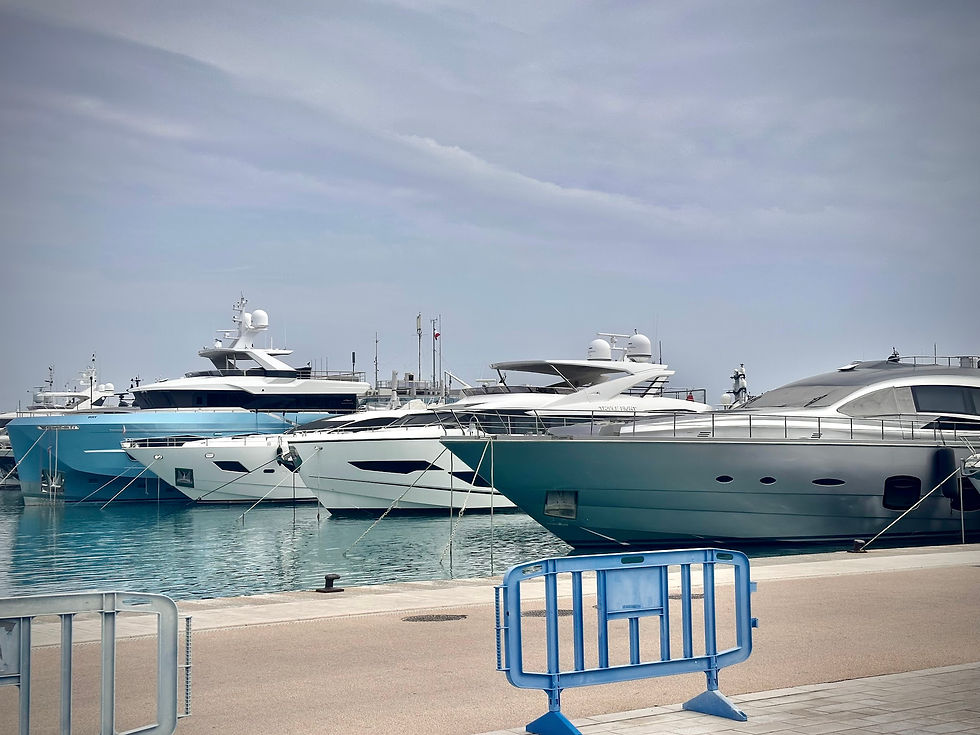
And then there is Port Vauban, where the scale changes completely: old ramparts, contemporary sculpture and a harbor filled with some truly extraordinary superyachts. It is an amusing contrast after a morning spent looking for tiny faces hidden in stones. If looking at the yachts makes you want to get onto the water yourself, you can also charter a speedboat with a skipper for the day and explore the coast from the Mediterranean. With Antibes, Cap Ferrat, the Lérins Islands and Cannes strung along this stretch of coastline, seeing it from the water gives you an entirely different perspective.
Where to stay and eat in Antibes
Over in Juan-les-Pins, Hôtel Belles Rives has a wonderful story. F. Scott and Zelda Fitzgerald lived here in 1925, when it was still the seaside Villa Saint-Louis, and Fitzgerald began writing Tender Is the Night here. The hotel still embraces its Art Deco and Jazz Age history, with 43 rooms and suites, a private beach, the Fitzgerald piano bar and Michelin-starred La Passagère overlooking the Mediterranean. {The beach is seasonal, so check dates if you are visiting off-season.}
Juan-les-Pins has serious jazz credentials of its own. Jazz à Juan began in 1960, and over the years the festival has brought Ella Fitzgerald, Ray Charles, Miles Davis, John Coltrane, Duke Ellington and many others to the pine grove beside the Mediterranean. If you are here in July, check the festival calendar—but expect a very different version of the quiet Riviera I am describing here.
Cap d'Antibes Beach Hotel offers a more contemporary beach-resort experience and is part of Relais & Châteaux, a collection I generally like. Its restaurant Les Pêcheurs sits directly on the water.
For another special meal, Maison de Bacon on Cap d'Antibes is known for seafood, particularly bouillabaisse and local fish, with a spectacular position overlooking the sea.
Planning a Côte d’Azur trip?
I can help with hotels, routing, restaurant recommendations and the details that make a trip work well. When you book certain hotels through me, I can also often provide preferred-partner benefits such as complimentary breakfast, hotel or resort credit, room upgrades when available, and early check-in or late checkout when available. The exact benefits depend on the hotel and rate.
About the Author
Jody Holman is a travel advisor, photographer and founder of Viewfinder Travel. She designs thoughtful, highly personalized journeys informed by firsthand travel, trusted global partners and a photographer’s eye for place.
All photos copyright Holman Photography 2025


Comments